
 Loading...
Fullscreen














 0
Loading...

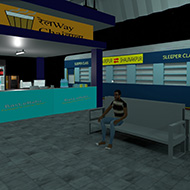
You slide a fresh glass of Kokila Kola across the counter, wipe your hands on your apron, and hear the next train groaning into the platform behind you. Railway Chai Wala puts you behind Ramu’s stall from the very first minute, with no tutorial screen standing between you and the next order.
| Genre | Psychological Horror Simulation |
| Perspective | First-Person |
| Protagonist | Ramu, a station chaiwala |
| Setting | Fakripur railway station |
| Mode | Singleplayer, Story-driven |
The first stretch of Railway Chai Wala is built around a deceptively simple loop: brew the chai, fry the samosas, hand over a vada pav before the next train pulls the crowd away. Passengers line up with specific requests, and Ramu has to keep the stall moving without letting orders pile up. It plays like a game about patience as much as speed, because the station never actually stops.
Early on, most of what you’re doing is learning the rhythm of the counter. Where the kettle sits, how long the samosas need before they’re ready, which passengers want coffee instead of chai. None of it is complicated on its own, but doing it all at once, while trains keep arriving, is where the tension starts to creep in.
Sim-focused players tend to enjoy this stretch the most, since it rewards efficient movement and clean multitasking at the stall. It’s a short list of tasks, but the timing matters more than it first appears.
New players usually try to rush every order the second it appears, which backfires once two or three passengers start waiting at once. The stall isn’t designed for panic; it’s designed for sequencing. Get the chai brewing first, then handle the samosas while it steeps, and the counter stays manageable.
The second mistake is treating passenger dialogue as filler. Conversations at the stall are where Fakripur’s stranger details start showing up, and skipping through lines quickly means missing small cues that matter later. Players chasing the horror side of the experience specifically slow down here.
Difficulty in Railway Chai Wala isn’t about faster enemies or harder puzzles. It’s about the atmosphere shifting under you while the job stays the same. By the time the crowd thins out and the platform lighting changes, the same stall you were casually running an hour earlier starts to feel like the wrong place to be standing still.
This is the section players discuss most in reviews. One of the more common comparisons is to Fears to Fathom, and it’s an accurate one: grounded, everyday tasks that slowly curdle into something uneasy, without ever fully abandoning the mundane setting that made the opening hours comfortable.
Story-first players tend to push through this stretch quickly, curious about Ramu’s situation, while completionist types linger to make sure they’ve caught every strange detail the station has to offer before moving on.
Player discussion around the game tends to split fairly evenly. Some call it a slow-burn that earns its unsettling turn precisely because the chai-and-samosa routine feels so lived-in first. Others think it leans more darkly comic than genuinely frightening, and that’s a fair criticism worth acknowledging rather than glossing over.
Its review standing backs up the warmer reaction, sitting at 96 percent positive across its early user reviews. That’s a strong number for a game this compact, and it lines up with how often players describe the runtime as tight rather than padded.
It’s closer to unsettling than terrifying. There are no traditional jump scares built around the counter work itself; the discomfort comes from Fakripur’s atmosphere shifting while Ramu’s daily tasks stay the same.
It’s built as a single, focused sitting rather than a sprawling campaign. Most of that time is spent split between stall duties and passenger conversations, with the mystery unfolding gradually between orders.
Serving passengers accurately matters more for immersion and dialogue than for hard failure states. Missing an order at Ramu’s stall won’t lock you out of the story, but it will cost you some of the small character moments tied to specific requests.
Underneath the samosas and the Kokila Kola bottles, Railway Chai Wala is really about watching Fakripur station change while Ramu keeps doing the only job he knows how to do.
There are no reviews yet. Be the first one to write one.